GEO for B2B Brands: Why Your Prospects No Longer Read Reviews Themselves
51% of B2B software buyers now start their research in an AI chatbot, up from 29% a year earlier. Human traffic to review sites is collapsing, but their weight in chatbot answers is rising.
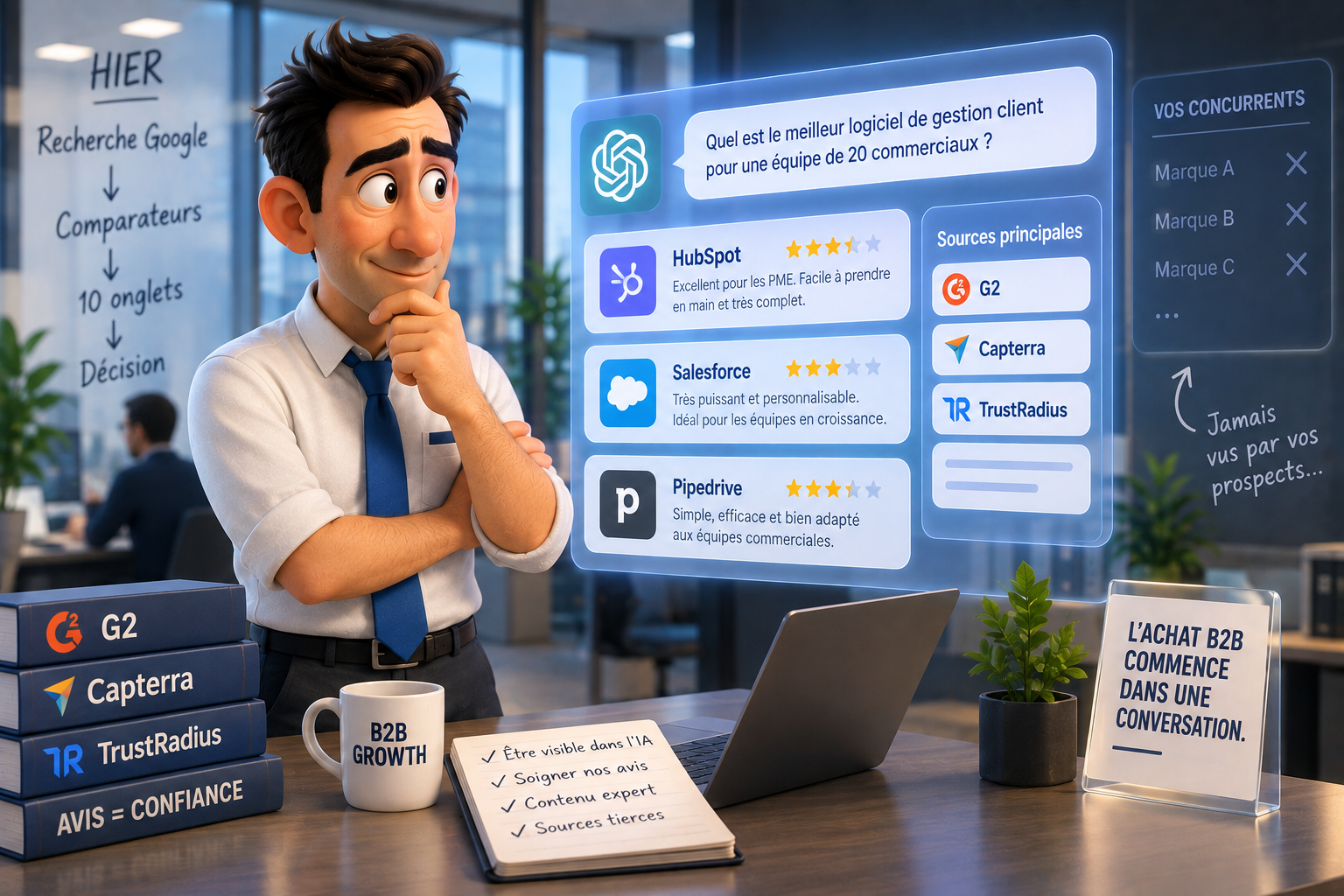
GEO — the art of being visible in the answers given by chatbots like ChatGPT, Claude, or Gemini rather than in Google's blue links — doesn't play out the same way depending on who's buying. A brand selling to individual consumers and a brand selling to other businesses (what's known as B2B, for "business to business") aren't playing on the same field. The latter is losing control of its sales funnel without even realizing it.
In April 2026, G2, one of the largest online review platforms for business software, published a number that should alarm any B2B marketing team. 51% of software buyers now start their research in an AI chatbot, up from 29% a year earlier. ChatGPT alone captures 63% of that activity. Over the same period, human traffic to G2's site dropped 84.5%, its competitor Capterra's by 89%, and TrustRadius's by 92%. These three names are the reference sites where businesses publish and read reviews on business software, the B2B equivalent of a specialized Trustpilot. A study by 6sense of nearly 4,000 B2B buyers confirms the trend on a larger scale: 94% of them use an AI chatbot at some point in their buying journey.
These numbers don't tell the story of review sites dying. They tell the story of a shift. Buyers aren't giving up on reading customer reviews, they're giving up on going to read them themselves. A chatbot does it for them, synthesizes, compares, and recommends three tools before a salesperson has even known a prospect existed. For a B2B brand, the question is no longer whether it shows up on the first page of Google. It's whether it's one of the three names ChatGPT cites when a buyer asks "what's the best CRM software for a team of 20 salespeople."
A buying cycle that starts outside your control
B2B selling has always had a long buying cycle, with several decision-makers and a silent research phase before any sales contact. GEO doesn't create this dynamic, it moves it further upstream. What used to happen on Google, on comparison sites, and on specialized forums now happens in a conversation with a chatbot, invisible to you, leaving no trace in your CRM, nothing to observe in your site statistics.
A direct and underestimated consequence: 69% of buyers surveyed by G2 say they chose a different vendor than the one they initially had in mind, based solely on a chatbot's recommendations. A third bought a tool they had never heard of before the conversation. The shortlist a prospect builds before ever talking to a salesperson is no longer the product of their own experience or word of mouth. It's the product of a synthesis produced by a chatbot, from sources it deems reliable. If your brand isn't among those sources, you're not just losing a click. You're losing the sale before it ever existed.
Take an operations director looking for inventory management software for an industrial SME. Two years ago, they would have typed their query into Google, clicked on three or four results, compared pricing grids across ten open tabs. Today, they ask ChatGPT the question in one sentence, get three names with their strengths and limitations, and only contact the ones that come out of that synthesis. The salesperson for the software left out of that answer will never know an opportunity existed. No form filled out, no trace in their CRM, just a silent absence in a conversation no measurement tool can capture.
G2, Capterra, TrustRadius: the trust base behind AI chatbots
Here's the paradox many marketing teams haven't yet come to terms with. Human traffic to review sites is collapsing, but their weight in AI chatbot answers is growing. A Quoleady study of near-purchase searches, of the "[software] alternatives" type, found that 100% of recommended tools had reviews on Capterra and 99% on G2. These platforms are no longer read by humans, they're being digested by models as aggregated social proof. A chatbot treats a review published on G2 as a more reliable signal than a product page, because it carries the mark of an independent judgment.
A report published by G2 in early 2026 goes further: the platform's recent acquisition could push its share of citations in pre-purchase answers up by 76%, simply because the volume of reviews it aggregates becomes strategic raw material for the models. For a B2B brand, ignoring its presence on these platforms while betting everything on its own site is a miscalculation. The corporate website remains useful for convincing a prospect once they've arrived. It carries almost no weight in the phase where the chatbot builds its recommendation.
What sets selling to businesses apart from selling to consumers
Consumer-facing GEO, the kind aimed at individuals (B2C, "business to consumer"), tries to get a product into a one-off recommendation: what's the best sunscreen, which vacuum to buy. GEO aimed at businesses plays a different game. It tries to build perceived authority across an entire category, because the final decision involves several people, several research sessions, and a comparison that stretches over weeks.
| Dimension | Selling to consumers | Selling to businesses |
|---|---|---|
| Goal | Show up in a one-off recommendation | Be perceived as a reference across the whole category |
| Sources that matter | Reddit, product reviews, consumer comparisons | Professional review sites, technical documentation, expert publications on LinkedIn |
| Decision | Fast, often a single person | Long, several decision-makers to convince |
| Content that carries weight | Short reviews, social content | Detailed comparisons, case studies, technical proof |
Three levers matter in particular when selling to businesses. First, the depth of technical documentation: a chatbot that has to answer "does this tool connect with Salesforce" will look for a precise integration page, not a marketing pitch. Second, honest comparative content: pages that fairly compare a product to a competitor, without hiding its limitations, get cited more often than pages that only praise their own merits, because they answer directly to the implicit question of a buyer in the selection phase. Third, the credibility of the company's experts, on LinkedIn in particular, which strengthens the trust models place in a source before citing it.
A B2B buying committee averages six to ten people, each with their own criteria. The technical lead is looking for an answer on security and integrations with other software. The finance lead wants to understand total cost over three years. The future end user wants to know if the tool is pleasant to use day to day. A chatbot queried by each of these profiles will look for different sources to answer different questions. A brand that only covers the product angle, without solid security documentation or clear financial content, loses citations on half the questions its own buying committee is asking.
Invisibility now costs more than it used to
A third of B2B buyers today buy a tool they didn't know about before their conversation with a chatbot. That number needs to be read both ways. It's a threat to established brands that thought their position was secured by their historical name recognition. It's a real opportunity for smaller or newer players, who can earn a spot in an AI recommendation without a market leader's budget, provided they've built the right signals: structured presence on review platforms, clear and accessible documentation, honest comparative content, identifiable expert voices.
The real risk isn't doing GEO badly. It's continuing to measure performance only with yesterday's tools. A team that tracks its traffic to G2 and reads its decline as a sign of waning market interest is missing the opposite signal: the market is still reading those reviews, just through a chatbot intermediary. The question to ask every quarter is no longer "how many visitors on our product page," it's "when a buyer in our category asks ChatGPT or Perplexity, are we in the answer."
Vurto tracks this question precisely for B2B brands: which queries generate a citation, which sources carry weight in the answer, and where the gaps are against the competition.