AI Chatbot Traffic Is Tiny. It's Worth Gold
Traffic sent by ChatGPT or Perplexity barely accounts for 1% of a site's total traffic, yet it converts up to nine times better than a classic Google search.
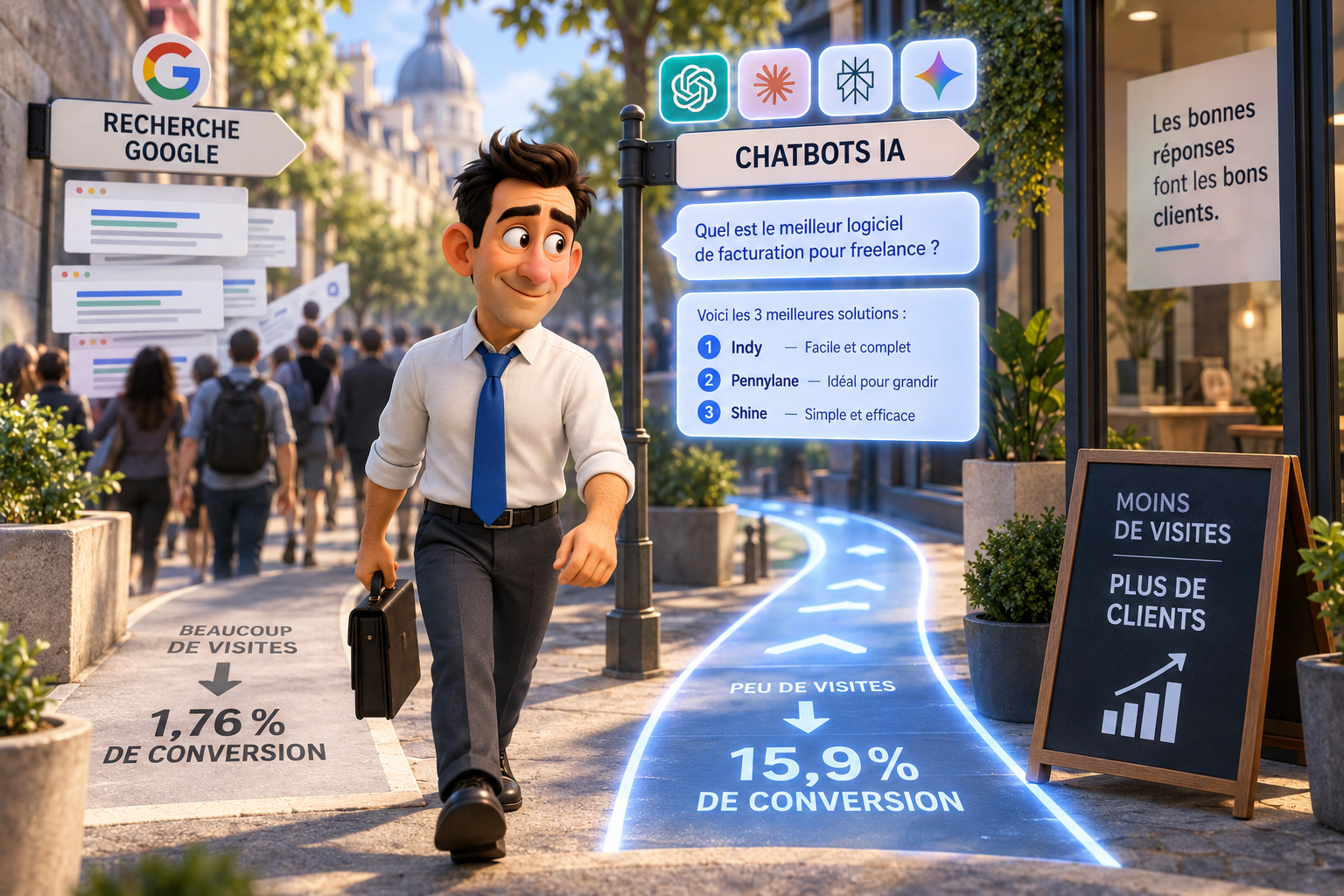
A US agency, Seer Interactive, compared two sources of visitors on the same site: those arriving from ChatGPT, and those arriving from a classic Google search. Result: 15.9% of the former end up buying or filling out a form, versus 1.76% of the latter. Almost nine times more. Microsoft, using its Clarity analytics tool, observed the same thing across more than 1,200 media and publisher sites: visitors coming from a chatbot sign up eleven times more often than those coming from a classic Google search. A study of 94 e-commerce sites measured a more modest but real gap: 31% more conversions for ChatGPT traffic compared to a Google search that doesn't include the brand name.
These numbers vary from study to study, sometimes a lot, because the calculation methods differ. But they all point in the same direction. Traffic sent by an AI chatbot converts noticeably better than classic traffic. The problem is that it accounts for barely more than 1% of a site's total traffic, according to measurements from the analytics tool Conductor. A marketing team that only looks at volume misses the most useful piece of information on its dashboard.
Why a visitor from a chatbot buys more often
The answer lies in how the question was asked before the person even arrived on the site. When someone types "best invoicing software for freelancers" into Google, they get ten links and still have to compare, sort, and hesitate. When they ask the same question to ChatGPT, the model has already done that work. It has read several sources, compared the options, and returns only the two or three names that best answer that person's specific request. The visitor who clicks the final link is no longer searching, they're verifying a decision that's already been nearly made.
It's the difference between a customer who walks into a store to browse, and a customer who walks in already knowing what they want to buy, on the recommendation of a friend they trust. The chatbot plays that role of trusted intermediary. It has filtered, explained, compared. The person landing on your site no longer needs to be convinced of the product's general value, only reassured on the details.
A report published in March 2026 confirms the scale of the phenomenon: visitors coming from AI assistants like ChatGPT or Perplexity convert 42% better than non-AI traffic, across all channels combined. The quality of the intent that precedes the visit changes the nature of the visitor itself.
Take a concrete example. Someone looking for payroll software for ten employees types their question into Perplexity. The engine answers by citing three tools, each with an indicative price, a strength, and a limitation. They click on the one that best fits their situation, land on a pricing page, and request a demo that same day. The same buyer, starting from a classic Google search, would probably have opened five or six tabs, compared reviews for an hour, then put off the decision until the next day. The chatbot didn't just shorten the path. It did the filtering on their behalf, and that filtering translates directly into conversion rate.
Advertising is still useful, but for a different goal
This isn't about pitting advertising against visibility in AI chatbots as two competing strategies. They serve different needs. Advertising pays for immediate, controllable volume: you know how much you're spending, how many visitors you're getting, and you can adjust the budget from one day to the next. Getting cited by an AI chatbot doesn't work the same way. It's built over time, through clear content, visible customer reviews, technical documentation that the models reading it can access.
The conversion gap between the two channels doesn't mean you should cut your advertising budget. It means that a euro invested in the quality of what AI chatbots find about a brand produces a return that shows up in no advertising campaign dashboard, and that return will grow mechanically as buyers increasingly use these tools.
What this changes in how you measure performance
Most marketing dashboards are built around volume: number of visits, number of ad clicks, number of impressions. That logic makes sense for paid advertising, where each visit has a direct, predictable cost. It becomes misleading for traffic generated by AI chatbots, where volume will stay modest for a long time but where each visit carries more weight.
The table below summarizes the gap observed across several recent studies, with different methodologies, which explains the variation in the numbers:
| Traffic source | Observed conversion rate | Relative volume |
|---|---|---|
| Classic Google search | Baseline (1x) | High |
| Visitors from an AI chatbot | 4x to 11x depending on the study | Low, often under 1% of the total |
| Paid advertising | Variable, heavily dependent on cost per click | High but costly to sustain |
Comparing a channel that accounts for 1% of traffic to a channel that accounts for 60% in raw volume doesn't make sense. The right question isn't "how many visitors does the chatbot send us," it's "what is the value of a visitor sent by a chatbot, compared to that of a visitor from an ad." On that basis, a budget devoted to being well cited in AI chatbot answers can pay off more, visitor for visitor, than an equivalent ad budget, even if the total number of visitors remains incomparable for now.
A signal that will carry increasing weight
Traffic from AI chatbots remains marginal today, but its trajectory is clear: it grows every quarter, while classic organic traffic flattens out. A team that invests now in its visibility within the answers given by ChatGPT, Perplexity, or Gemini isn't just building one more channel. It's capturing a stream of pre-qualified visitors, fewer in number but far more likely to become customers, before this channel gets big enough for everyone to chase it at once.
The logic of classic advertising is still useful for generating volume quickly. But a budget aimed entirely at volume, with nothing invested in the quality of what arrives via generative engines, ignores the underlying trend in buying behavior. The next quarter won't be won just by attracting more people, but by attracting the right people, at the right moment in their decision.
Vurto measures the share of your traffic that genuinely comes from citations earned in ChatGPT, Perplexity, Gemini, and Claude, to tell apart what's small in volume but big in value.