Perplexity, ChatGPT, Gemini: Three Engines, Three Source Lists, One Mistake to Avoid
Out of 680 million citations analyzed, only 14% of cited sites dominate across all AI chatbots. Between ChatGPT and Perplexity alone, overlap drops to 11%: three engines, three distinct selection logics.
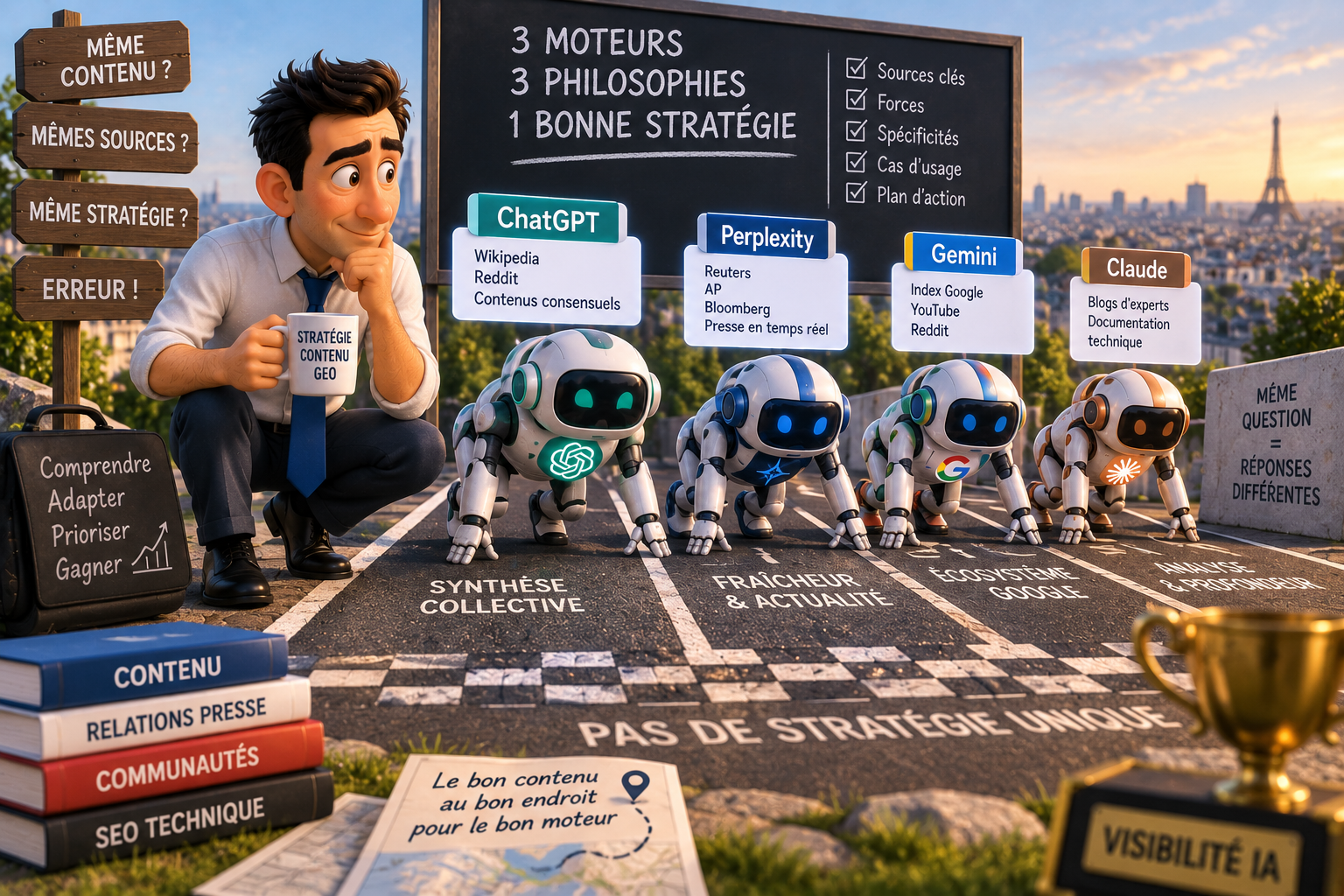
A number to start with. Out of 680 million citations analyzed between August 2024 and April 2026 by the 5W index, only 14% of cited sites dominate across all AI chatbots (these conversational assistants like ChatGPT, Gemini, or Perplexity, able to answer in natural language from sources they select themselves). Between ChatGPT and Perplexity alone, overlap drops to 11%. In another study covering 11,500 queries compared against Google results, GPT-4o shows 0% median overlap with Google's top 10. Perplexity, 14.3%. Gemini, 8.5%.
These numbers should settle a debate that has dragged on for two years in marketing teams: no, "being visible in AI" is not a single objective. It's three different objectives, with three different selection logics, and a good part of the groundwork consists of understanding which one applies to which client.
Three philosophies, not three variants of the same engine
The starting mistake is to treat ChatGPT, Perplexity, and Gemini as competitors doing the same thing with different branding. They are three architectures that answer different questions about what makes a good source.
ChatGPT relies heavily on consensus-based, already-aggregated content. Wikipedia accounts for between 26% and 48% of its top 10 citations depending on category. Reddit comes right behind, with a weight exceeding 40% across all categories and engines combined, and staying particularly high with ChatGPT. The logic is that of a model favoring what has already been collectively validated: content synthesized, debated, corrected by thousands of contributors.
Perplexity works the opposite way. Its engine queries the live web on every request rather than drawing from a fixed memory, which explains why it favors Reuters, AP, Bloomberg, the Wall Street Journal: news sources with strict attribution and verifiable freshness. A Columbia Journalism Review study measured a citation error rate of 37% for Perplexity Sonar Pro, versus 67% for ChatGPT Search. The gap comes down to method: searching live and citing your source produces fewer fabrications than rephrasing from training memory.
Gemini, finally, remains Google's child. It draws from the search engine's index, from YouTube (which Google owns), and shares with AI Overviews a clear fondness for Reddit. It's the engine closest to classic SEO culture, the one where web ranking, domain authority, and presence across the Google ecosystem still count directly.
Claude, often looked at from a distance in these comparisons for lack of search volume, stands out for a taste for long-form analysis and technical documentation. It cites proportionally more expert blogs and less Reddit than the others.
The table that changes the roadmap
| Engine | Preferred sources | Dominant logic |
|---|---|---|
| ChatGPT | Wikipedia, Reddit, consensus content | Trained memory + collective synthesis |
| Perplexity | Reuters, AP, Bloomberg, press with attribution | Real-time search, freshness |
| Gemini | Google index, YouTube, Reddit | Google ecosystem, classic SEO |
| Claude | Expert blogs, technical documentation | Long-form analysis, depth |
This table isn't an exercise in curiosity. It dictates where a brand needs to exist depending on which engine matters most to its audience. A B2B software vendor (selling to other businesses rather than individuals) whose prospects mainly use Perplexity to compare solutions is better off working on press relations and citations in serious trade media, far more than optimizing a Reddit thread. A consumer brand that lives and dies on ChatGPT has the opposite interest: community conversation outweighs the press release.
What the low overlap actually means
The most underestimated point isn't the list of preferred sources. It's the fact that they barely overlap at all. Content that breaks through on ChatGPT can be invisible on Perplexity, and vice versa. This means a content strategy designed for "generative AI" in general, without distinguishing between engines, is in reality optimizing for a single engine without realizing it, usually the one the brand heard about first, often ChatGPT because it concentrates most of the usage volume.
In France, this concentration reaches extreme levels: ChatGPT captures 84.47% of clicks generated by AI assistants according to SE Ranking, Perplexity 12.82%, Gemini 2.08%. An AI visibility budget that ignores this split and treats the three engines equally wastes precious time. But the reverse is also true over an eighteen-month horizon: Gemini is natively built into Android, into Google Workspace, into the Google search bar itself. Its share of usage is growing faster than its share of citations today would suggest. Ignoring Gemini because it accounts for 2% of current clicks is like ignoring mobile in 2010 because it still represented only a fraction of web traffic.
The practical consequence fits in one sentence: stop measuring "AI visibility" as a single score. Content can be cited ten times a week on ChatGPT and never on Perplexity without that being a failure, if the brand's target audience lives on ChatGPT. But no one can know that without tracking the engines separately, each with its own citation logic, rather than an average that hides everything.
Adapting content to each engine's logic, not to a universal checklist
Concretely, this changes three things in how content gets produced.
To exist on ChatGPT, you need to feed the collective conversation rather than bypass it. A structured presence on Reddit in the right communities, an up-to-date Wikipedia entry if the brand or its leader has a place there, content that synthesizes a topic rather than selling it. It's ecosystem work, not landing-page work.
To exist on Perplexity, freshness and attribution matter more than volume. A well-distributed press release, relationships with journalists who cite the brand with a clear link, dated content republished regularly carry more weight than a static white paper published once and never touched again.
To exist on Gemini, classic web ranking fundamentals remain the best way in: domain authority, clean technical structure, YouTube presence. It's the engine where the last ten years of SEO work keep paying off directly, which paradoxically makes it the easiest to work on for a team coming from classic search.
None of these three approaches replaces the other two. A brand with the time and budget to do all three builds robust AI visibility, insensitive to a single engine's algorithm changes. A brand that has to choose should first look at where its audience actually asks its questions, not where it itself is most comfortable producing content.
Tracking three engines beats guessing on one
The low overlap between ChatGPT, Perplexity, and Gemini isn't a technical problem to solve. It's a structural constraint to build into how you measure and prioritize. A brand that only tracks its citations on one engine is flying blind on the other two, and makes content decisions based on a third of reality.
This is exactly why Vurto tracks citations separately across ChatGPT, Gemini, Perplexity, and Claude rather than producing one aggregated score that erases these differences: a brand needs to know which engine it exists on, which one it's absent from, and why the two don't look alike.