The French media outlets AI chatbots actually cite
Le Monde appears in 64.4% of tested ChatGPT answers, France 24 in 82.2% on international news: the ranking of the French media outlets ChatGPT actually cites, the role of Wikipedia, and what it changes for a press relations strategy.
A PR agency lands an interview in a specialist magazine. Three weeks later, the client asks whether it made any difference on ChatGPT. Nobody can answer, because nobody has ever looked at what AI chatbots actually retain from the French press.
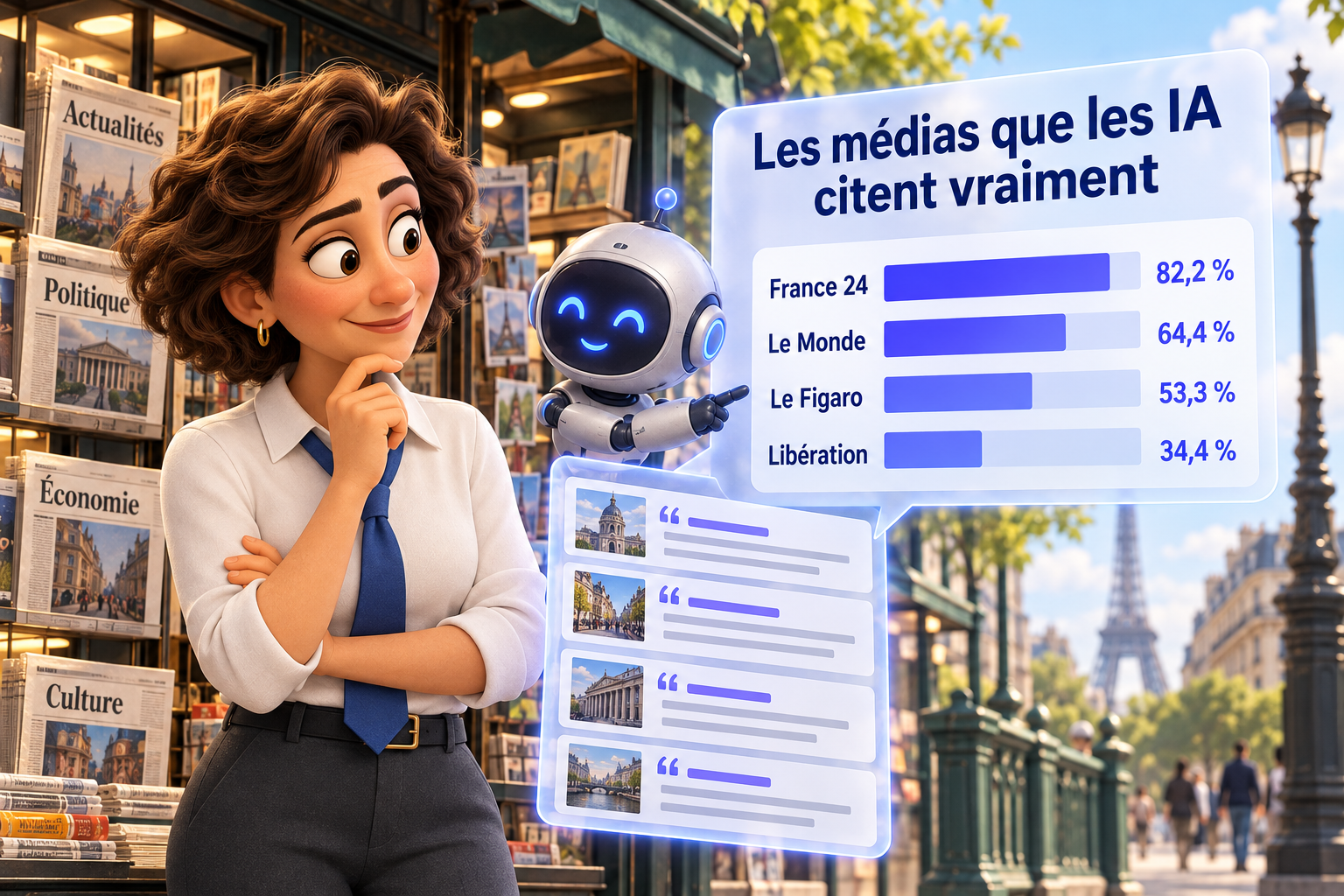
The question is rarely asked, even though it is starting to get figure-backed answers. In 2025 the agency Eskimoz published a GEO barometer on French media: around thirty news-related prompts, put to ChatGPT only, with data collected in July and August 2025 using its LLM Ranking tool (Eskimoz methodology). The often-quoted figure of 1,200 sites and 50,000 prompts tracked over 60 days covers all of Eskimoz's sector barometers (media, luxury, tourism and others), not the media study alone. The resulting ranking has almost nothing to do with the industry's usual pecking order.
The ranking that surprises
On general news prompts, Le Monde is cited in 64.4% of ChatGPT's answers. Le Figaro follows at 53.3%. Then the gap widens: Libération at 34.4%, Les Echos at 27.8%, franceinfo at 24.4%. On international news, two titles from the France Médias Monde group dominate by a wide margin: France 24 at 82.2%, RFI at 57.8%, far ahead of Euronews at 30%. In women's and lifestyle media, the gaps are tighter: Elle at 13%, Femme Actuelle at 10.8%, Le Journal des Femmes at 7.4%.
| Category | Outlet | Citation rate (ChatGPT, July-August 2025) |
|---|---|---|
| General news | Le Monde | 64.4% |
| General news | Le Figaro | 53.3% |
| General news | Libération | 34.4% |
| General news | Les Echos | 27.8% |
| International | France 24 | 82.2% |
| International | RFI | 57.8% |
| International | Euronews | 30% |
| Lifestyle | Elle | 13% |
These figures measure citation frequency, not audience. A title can be read by millions of people every day and remain almost invisible to a chatbot if the way it publishes does not match what these tools can read. The same barometer also estimates the traffic ChatGPT sends back to these sites: over six months, about 2.3 million visitors for Le Monde, 811,700 for Le Figaro and 295,700 for BFMTV, based on audience analytics data reworked by Eskimoz. Real volumes, to be weighed against what these newsrooms still get from traditional Google search.
Why Wikipedia remains the hidden intermediary
Here is the detail that changes how this ranking should be read. According to Eskimoz, these outlets appear on ChatGPT mainly through Wikipedia: the encyclopedia cites them in its footnotes, and the chatbot leans heavily on it to build its answer. A separate study by Profound, covering ChatGPT, Google AI Overviews and Perplexity between August 2024 and June 2025, points the same way: on ChatGPT, Wikipedia accounts for 47.9% of citations among the ten most-cited sources, ahead of Reddit (11.3%) and Forbes (6.8%). Measured against all of ChatGPT's citations, Wikipedia weighs 7.8% (Profound, AI Platform Citation Patterns). Citation shares move a lot from one study and one month to the next. Semrush, which tracked more than 230,000 prompts from July 14 to October 12, 2025, saw the share of ChatGPT answers citing Wikipedia drop from about 55% to under 20% in mid-September 2025 (Semrush). A single figure describes one engine, one method and one period, not a rule.
A news title that wants to weigh on an AI chatbot's answers is therefore not only competing with its direct rivals. It is up against an invisible filter: being picked up by the online encyclopedia, being cited by other pages Wikipedia considers reliable, writing factual, dated articles rather than opinion pieces that are hard to verify. Wikipedia has its own notability and sourcing rules, written by volunteers, and nobody gets in just by asking. A solid, factual press article, picked up by other sources, stands a better chance of leaving a lasting trace there than a self-promotional press release.
Perplexity follows a different logic, closer to real-time search. In the same Profound study (August 2024 to June 2025), Reddit accounts for 46.7% of citations among its top ten sources and YouTube for 13.9%, which is 6.6% and 2.0% of all its citations. Depending on the metric, YouTube's weight changes a lot: Passionfruit, which tracked AI answers from August 2025 to February 2026, finds at least one YouTube video in 39.5% of Perplexity answers, because counting answers that cite a video is not the same as counting the share of citations (Passionfruit). Le Monde also signed a multi-year agreement with Perplexity in May 2025: the paper's content can appear in the tool's answers, with links to the articles, in exchange for payment. An outlet that negotiates this kind of deal makes its content directly available to the tool. An outlet that negotiates nothing depends on how the tool decides, on its own, to browse the web.
What it changes if you are not a media outlet
The temptation, reading this ranking, is to file it under "newsroom topic". That would be a mistake. Every brand hoping to be cited by an AI chatbot depends on this same hierarchy, because a large share of its visibility comes from what the press writes about it, not just from its own website.
A mention in an outlet that chatbots rarely consult is likely to stay invisible, however good it is. A more modest mention in Le Monde, Les Echos or France 24 stands, according to these measurements, a better chance of being picked up, rephrased, and cited back by a chatbot answering a question about your industry. It is not a matter of prestige. It is a matter of the probability of being read by a machine that has its favorite sources.
That means two things for a press relations strategy designed for the age of AI chatbots. First, choosing between two options that used to seem equivalent: ten niche specialist outlets, or a single piece in a general-interest title with a high citation rate. The second often carries more weight, even if it seems to reach a less targeted audience. Second, working on how the information circulates after the initial publication. An article that ends up cited in a Wikipedia entry, an industry comparison, or another outlet that picks up the story multiplies its chances of being picked up by a chatbot. An article that stays isolated on the newspaper's site, however well written, stops there.
And if your industry has no place in Le Monde
Not every brand is meant to appear in a general-interest daily. A machine-tool manufacturer, an accounting software publisher or a regional DIY chain will never interest Le Figaro, and that is not a problem. What matters for these sectors is to apply the same logic at the scale of their trade press: identify the two or three specialist titles that buyers in the category actually read, and check whether they are picked up elsewhere, archived, cited by competitors or industry comparison sites. A chatbot asked about a specific professional purchase will look for its sources in that small circle, not in the mainstream press. The hierarchy changes, but the principle stays the same: being cited is not enough, you have to be cited by the source the chatbot has learned to consult first on that specific topic.
That means being willing to drop some titles that still performed well in traditional press relations. An article in a prestigious print magazine that is never picked up online, never cited by a peer, never archived by a third-party site will carry almost no weight in a chatbot answer. A more modest article, published on a well-established trade site and picked up in two or three related articles, will carry more.
Measure rather than assume
The practical problem is that nobody can tell at a glance whether their brand benefits from this dynamic or is shut out of it. The only way to know is to ask the chatbots themselves the questions your customers ask, and look at which sources they cite when your brand appears, or when a competitor takes its place. A media name that keeps coming up in these answers shows where to focus your communication efforts. A name that never appears, despite good press coverage on paper, signals a problem worth digging into: article format, republication delay, lack of pickup by other sources.
This verification work should logically come before signing off on any press relations plan for 2026. An agency that still recommends a target media list based solely on audience or perceived reputation is working with the criteria of a world that no longer quite exists. The criterion missing from that list, and the one becoming decisive, is the probability that an AI chatbot will go looking for its answer at that outlet rather than another.
This is exactly what Vurto tracks: by querying ChatGPT, Perplexity, Gemini and Claude on the queries that matter to a brand, the tool identifies which sources these chatbots actually cite, outlet by outlet, and lets you compare that figure with the competitors tracked on the same questions.