ChatGPT, Perplexity, Gemini: the same disease, three different prescriptions
ChatGPT, Perplexity, Gemini and Claude do not draw on the same sources to build their answers. A site optimized for ChatGPT can be invisible on Perplexity: GEO starts by treating one engine at a time.
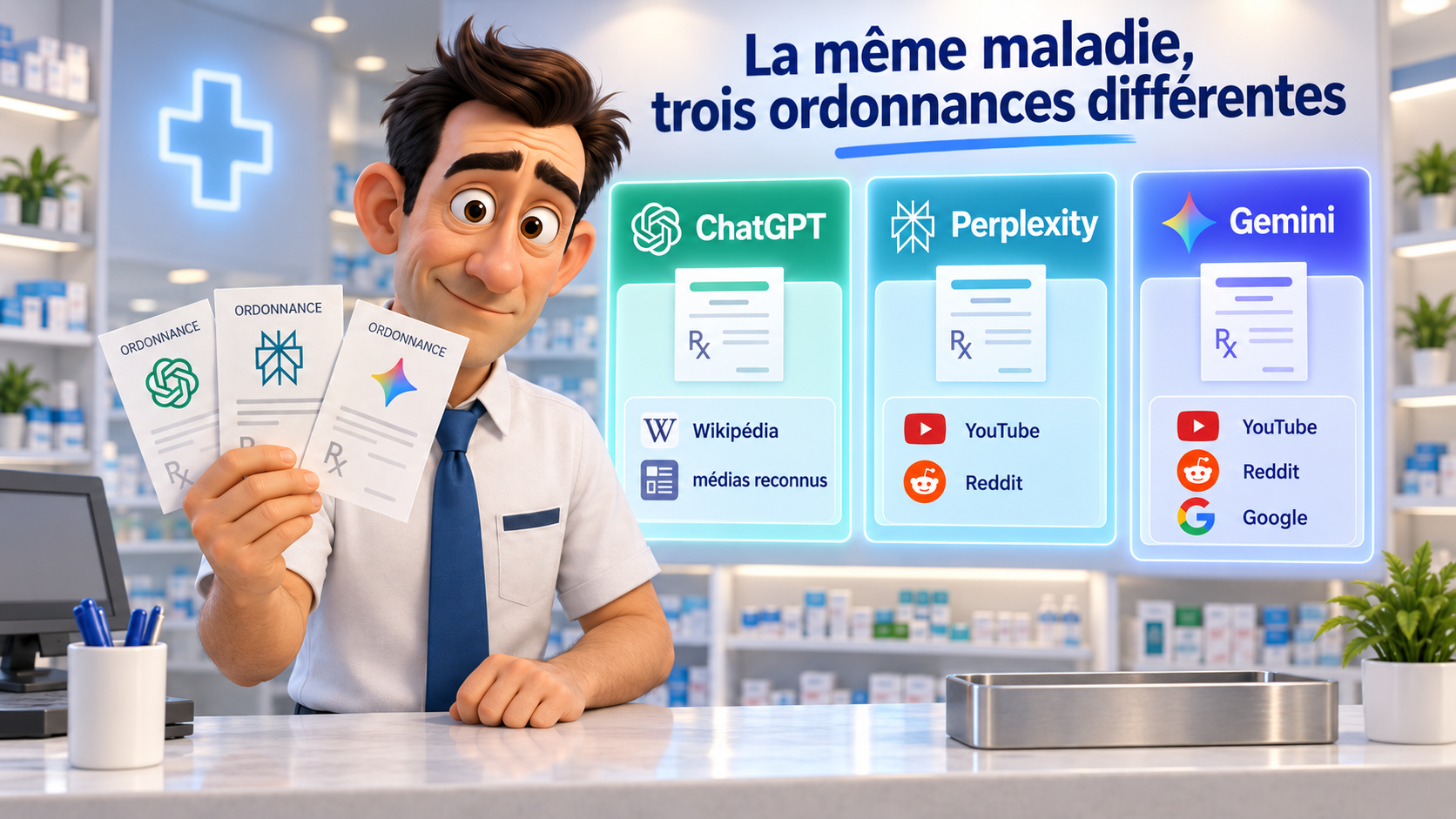
People often ask me the same badly worded question. "How do I become visible on AI?" AI does not exist. There is ChatGPT, Perplexity, Gemini, Claude. Four distinct organisms, each with its own way of digesting information. What they have in common: they are AI chatbots, software able to answer a question in natural language by fetching information on the web rather than relying only on what they learned during training. Their difference, the only one that really matters to you: they do not draw on the same sources to build their answer.
GEO, Generative Engine Optimization (the craft of making your brand visible and well perceived in the answers of these chatbots), starts with a simple diagnosis that is too often skipped. Stop treating these four tools as one uniform block. A site optimized for ChatGPT can be invisible on Perplexity. A brand that shines on Gemini may never show up on Claude. This is not a bug. It is the direct consequence of different architecture choices, made by different companies, with different interests.
Three patients, three biologies
Step back and look at how each engine picks its sources. Independent studies run on tens of thousands of citations in 2026 draw very sharp, almost caricatural profiles.
Perplexity behaves like a reporter who favors the field. It relies heavily on YouTube (around 30% of its citations in some analyses) and on Reddit, the forum platform where people discuss everything, often more candidly than a press release. Reddit can account for nearly half of its top ten sources. Perplexity prefers lived experience told by a stranger over the claim of an institutional website.
ChatGPT, for its part, leans toward established authority. Wikipedia holds a disproportionate place, and well-known media (Forbes, Reuters) complete the picture. The profile looks like a serious student who cites academic sources rather than comments from the neighborhood forum. But watch what comes next, because this profile moves fast.
Gemini, owned by Google, keeps the reflexes of a corporate librarian. It keeps citing the group's own properties widely (YouTube first) while keeping Reddit and Wikipedia in a good spot. A more balanced split, consistent with an engine that has access to the most complete search index on the web.
Claude, developed by Anthropic, completes the picture with yet another profile, closer to ChatGPT in its taste for documented sources, but giving a larger share to technical documentation and specialized sites when the question calls for it. Four engines, four biologies, and no common prescription.
A table beats a long speech here.
| Engine | Dominant sources | Profile |
|---|---|---|
| Perplexity | YouTube, Reddit | Field, lived experience, community |
| ChatGPT | Wikipedia, recognized media | Authority, formal knowledge, volatile |
| Gemini | YouTube, Reddit, Google properties | Balanced, anchored in the Google ecosystem |
| Claude | Documentation, specialized press, Wikipedia | Technical, precise, expertise-oriented |
Remember one thing from this table. Nobody builds an effective content strategy by targeting "AI" in general. You treat one organ at a time. An HR software brand that neglects Reddit cuts itself off from Perplexity. A clinic that never keeps an up-to-date Wikipedia page loses part of the credit it would deserve on ChatGPT. These are not technical details reserved for specialists. These are choices that decide which of your competitors gets recommended instead of you.
The patient who changes their mind every week
Here is the most underestimated point of the topic, and probably the most important. These profiles are not set in stone. A study covering 230,000 queries tracked over thirteen weeks showed that Reddit's share in ChatGPT answers went from about 60% in August to only 10% six weeks later. Wikipedia, in the same movement, dropped from 55% to under 20%. A collapse of that scale, over such a short time, on one and the same platform.
Meanwhile, Perplexity stayed remarkably stable, with minor variations on its usual sources. Gemini, too, changed little.
This contrast says something essential about these tools. ChatGPT probably adjusts its weightings continuously to avoid over-citing a handful of domains and looking like a biased engine. Perplexity and Gemini, with different sourcing logics, absorb these adjustments better. The message for you: a position won on one engine in September can vanish in October, without you having made any mistake. The ground moves under your feet. One more reason never to talk about "AI positioning" as a permanent gain, but as a state of health you monitor continuously.
What this concretely changes for your content
This heterogeneity has a direct consequence on how you should produce and distribute your content.
Stop betting on a single channel. If your content strategy is limited to blog articles optimized the classic search way, you may cover part of ChatGPT, but you stay invisible on Perplexity. An active presence in Reddit discussions relevant to your sector, YouTube videos that explain your product, an up-to-date Wikipedia page if your notoriety justifies it: these are different building blocks, for different engines, and none replaces the others.
Also beware of wins that rest on a single source. A brand that owes all its AI visibility to a handful of Reddit mentions lives on unstable ground, as we just saw with ChatGPT. Robustness comes from the diversity of entry points, forums, video, specialized press, well-structured product pages, kept up to date at the same time rather than one isolated bet.
And above all, do not confuse being cited with being well perceived. Appearing in an answer guarantees neither a favorable tone nor an accurate description of your offer. That is a topic in its own right, but it starts with the same prerequisite: knowing precisely where and how you appear, engine by engine, rather than guessing.
Take a concrete example. A company that sells software to businesses (what is called B2B, as opposed to selling directly to consumers) usually invests heavily in white papers and case studies published on its own site. This content feeds ChatGPT well, especially if it is picked up by the specialized press. But it barely feeds Perplexity, which will rather look for a customer's opinion posted on a forum or a commented LinkedIn post. Two audiences, two formats, two engines. The content budget must reflect that reality, not ignore it.
The diagnosis before the prescription
The temptation, faced with this complexity, is to give up and tell yourself that "AI moves too much to be worth our time". That is the reverse of the mistake we pointed out at the start. Movement does not exempt you from monitoring, it demands it. A serious company does not decide its sales strategy on an intuition from six months ago. It looks at this month's numbers. The logic is the same here.
What matters is knowing, for your brand and your competitors, which engines cite you, which sources they rely on to do so, and how that split evolves over time. Without that regular snapshot, you optimize blind, hoping that what worked on ChatGPT in the spring still works on Perplexity in the fall. That is a bet, not a strategy.
Vurto tracks these variations engine by engine, ChatGPT, Gemini, Perplexity and Claude, to show precisely which sources carry your visibility and which ones are collapsing before you find out by chance.