GEO: The Diagnosis Nobody Is Running
SEO measures your position in a list. GEO measures whether AI systems know you, understand you, and recommend you. The diagnosis almost nobody is running yet.
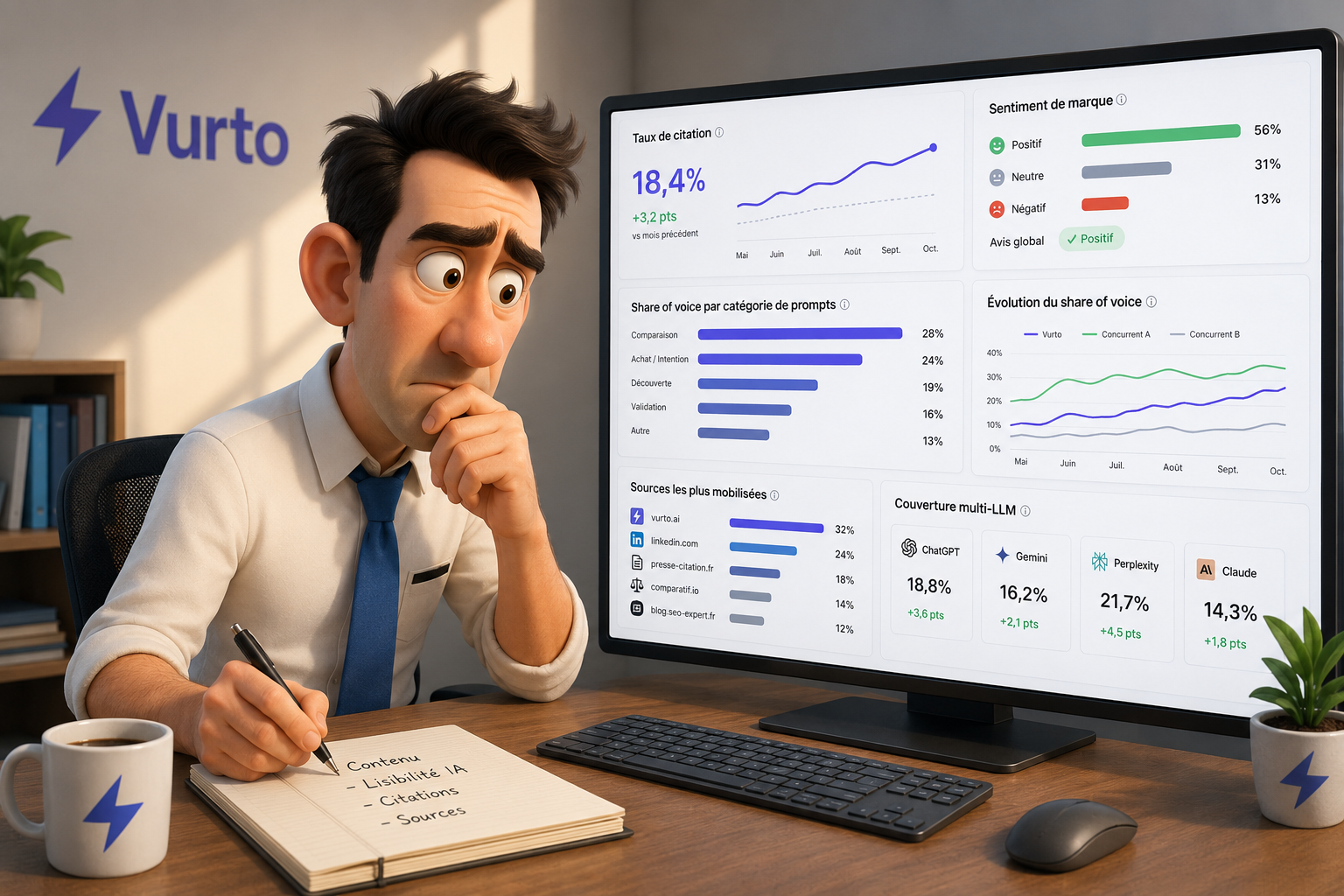
SEO has been optimized for thirty years. Rankings, backlinks, Core Web Vitals. All of it worked in a world where traffic flowed through lists of ten blue links.
That world is disappearing.
Today, a growing share of queries never produces a click. The AI answers directly. ChatGPT, Perplexity, Gemini, Claude — these models synthesize, recommend, conclude. They cite or they don't. And if your brand isn't in the answer, it doesn't exist.
That's the territory of GEO. Generative Engine Optimization.
What GEO Actually Measures
SEO measures your position in a list. GEO measures something more fundamental: do AI systems know you, understand you, and recommend you?
These aren't the same questions. And they don't have the same answers.
A site can rank first on Google and be invisible in ChatGPT's responses. Because LLMs don't read SERPs. They read what they ingested during training, what they fetch in real time through their search tools, and what their architecture lets them process.
GEO visibility rests on three layers.
The existence layer — do LLMs know you exist? Is your brand name, your products, your core arguments present in the sources these models draw from?
The readability layer — are your contents structured in a way that LLMs can process efficiently? A site that's technically opaque to an AI crawler is a site that's transparent to better-calibrated competitors.
The perception layer — when AI systems talk about your brand, is what they say accurate, positive, differentiating? Brand perception in LLMs is a signal you can measure, and almost nobody is watching it.
The GEO Diagnosis, Step by Step
The right diagnosis starts with the right questions.
Is my brand cited, and in what context? This isn't binary. A brand can be cited positively in Perplexity and absent from ChatGPT. Or present with a negative sentiment in Gemini. Multi-LLM coverage is the first diagnostic layer.
Are my contents readable by AI? LLMs process a well-structured markdown document very differently from a proprietary HTML product page or an unindexed PDF. Auditing the AI readability of your key content means finding blind spots before they cost you citations.
Do I understand the queries AI systems run about me? LLMs don't answer a user's question directly. They first break it down into sub-queries — fan-out queries — that they send to their search tools. If you don't know which fan-out queries apply to your category, you're optimizing blind.
Is my brand perception in AI consistent with my actual positioning? What LLMs say about your brand can diverge significantly from your official messaging. Identifying that gap means knowing where to act first.
Why the GEO Diagnosis Is Still Rare
The short answer: traditional SEO tools don't measure it.
Google Search Console gives you impressions and clicks. Ahrefs gives you backlinks. SEMrush gives you positions. None of them tell you what ChatGPT thinks of your brand this morning.
The GEO tools market is structuring fast, but maturity isn't uniform. Some platforms do citation monitoring. Others add recommendations. The most advanced ones, like Vurto, cover the full chain: multi-LLM monitoring, brand perception analysis, content recommendations based on fan-out and grounding queries, AI readability checks, and rewriting of strategic content (product pages, llms.txt, e-commerce catalog).
The question is no longer whether GEO deserves attention. That's settled. The question is how precisely you run the diagnosis before you start treating.
What Changes in Practice
For SEO teams: the skills transfer partially, but the reference frame shifts. You're no longer chasing a keyword ranking. You're trying to be the source an AI reaches for when a user asks a question related to your category.
For content teams: the writing angle changes. Not to please a ranking algorithm, but to be processable by an LLM. Clear structure, informational density, named entities, markdown format where possible.
For e-commerce teams: the product catalog becomes a major GEO asset. A poorly structured product page is a product page the AI won't recommend — even if it's perfectly optimized for Google.
For marketing leadership: AI visibility becomes a KPI in its own right, with its own benchmarks, trends, and alerts. Not once a quarter at the reporting meeting. Continuously.
The First Step
Run the diagnosis before prescribing. That's true in medicine. It's true in GEO.
Start by auditing your site's AI readability. Check whether your llms.txt exists and is properly configured. Ask ChatGPT, Perplexity, and Gemini about your brand and products yourself — what you read there is worth a thousand positioning reports.
Then build the monitoring. Not to have one more dashboard, but to know where you stand and where you're heading.
Vurto is a GEO tool covering the full diagnostic chain: multi-LLM monitoring, brand perception, AI readability, fan-out queries, and content rewriting for generative engines.