Google's AI Summary That Killed the Click
Google's AI-generated summaries now appear on 15 to 25% of searches and cut click-through to the sites ranked below by nearly 60%. Understanding what determines who gets cited is now essential.
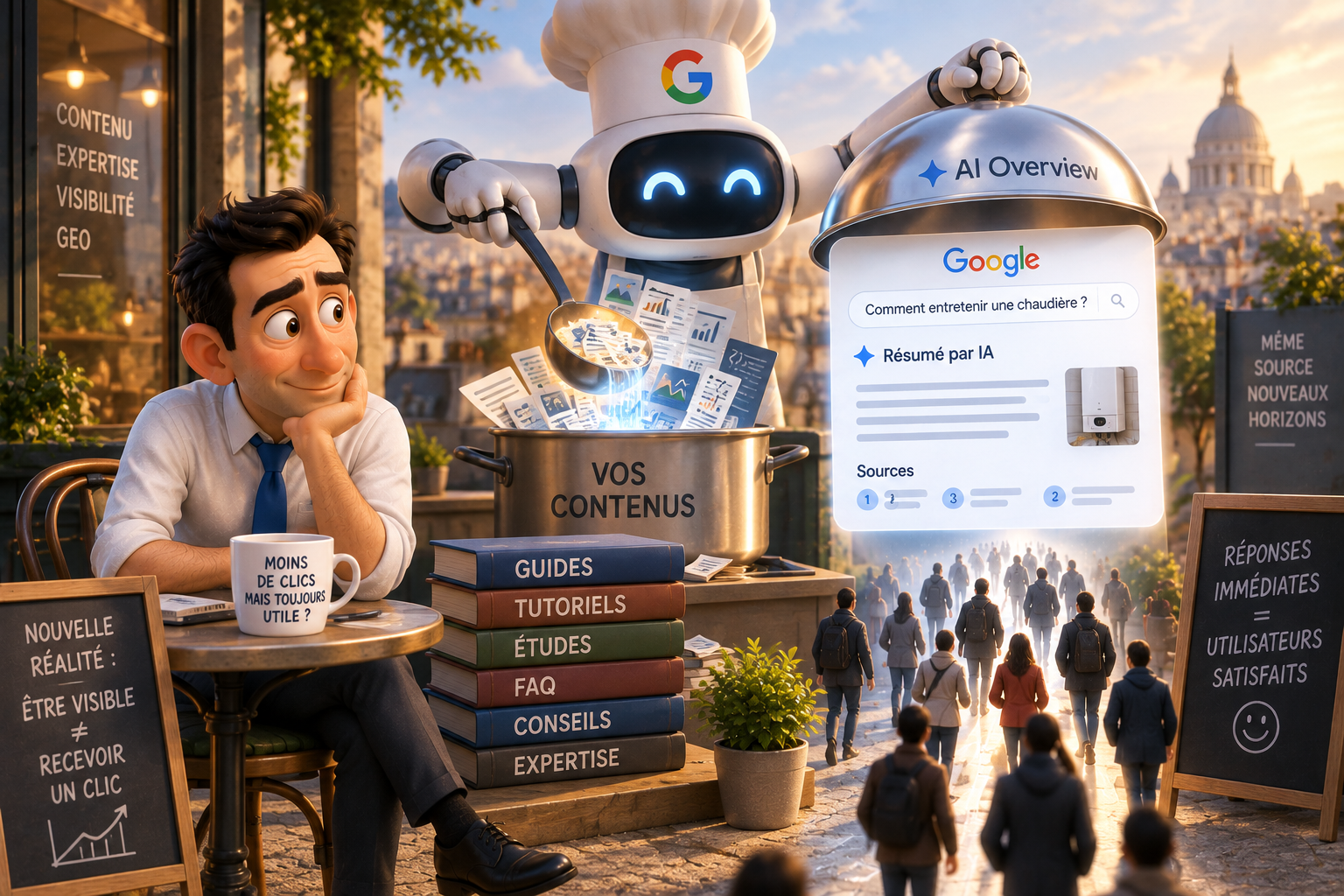
Type a question into Google today, and odds are a box appears right at the top of the page, ahead of the usual list of links. That box is called an AI Overview, literally an "AI-generated overview." A summary written by Google's AI model that answers the question directly, with a few small links off to the side. The person searching for information already has it in front of them. They no longer need to click on anything.
This box now appears on 15 to 25% of all Google searches, and up to half of searches when the question is informational rather than transactional in nature. Its direct consequence shows up in a number that should alarm any site that lives off Google traffic: when this summary appears, the click-through rate to the sites ranked below it drops by nearly 60%. A good chunk of the free traffic that thousands of businesses have built their visibility on for fifteen years is evaporating before their eyes, replaced by text that Google writes itself from their content, without sending them a single visitor in return.
A site can be the source and receive no visitors
The most disorienting part of this mechanism is that a site can supply the information shown in Google's summary without a single visitor ever clicking on it. On searches where this type of summary appears, 83% of people close the page without clicking on any link, neither the one in the summary nor those in the classic list. On Google's more advanced search mode, where AI takes up an even bigger share of the page, that figure climbs to 93%. More broadly, the share of Google searches that end with no click at all rose from 50% in 2019 to nearly 65% in early 2026, and reaches 68% in the United States over that same period.
This shift changes the very definition of what it means to "be visible" on Google. For twenty years, being well-ranked meant showing up at the top of a list of links and getting a click. Today, you can be the source cited in a summary, read by thousands of people, and never know it, because no visit shows up in the site's statistics. Visibility still exists, but it no longer automatically translates into measurable traffic.
Take a site that has published a detailed guide on boiler maintenance for years. It held the top spot on Google and got several hundred visits a day on that one page alone. Google's generated summary now captures the gist of that guide in a few lines, with a discreet link back to the source. The site's content answered thousands of people's questions this month. The site itself saw only a few dozen extra visits. The editorial work hasn't lost its value to the reader, it has simply changed who visibly benefits from it.
What determines who gets cited in the summary
Google's generated summary works on a logic close to that of chatbots like ChatGPT or Perplexity. The model has to choose, among the pages that best answer the question asked, which ones to cite and summarize. A poorly structured page, filled with sales pitches before getting to the point, or one that requires a lot of interaction to display its content, has less chance of being chosen than a page that answers directly and clearly from the very first lines.
Three elements come up in most analyses of pages cited by these summaries. First, an answer formulated in a self-contained, direct way, one that makes sense even taken out of its context, since that's exactly what the model is going to do with it. Second, a clear structure, with headings that announce the content that follows, rather than one long continuous block of text where the information gets buried. Third, a perceived authority on the topic covered, built through the consistency and regularity of the content published on that theme, not through a single article, however well written.
| What helps you get cited | What limits your chances of being cited |
|---|---|
| Clear answer from the first lines | Sales pitch before the answer |
| Headings that structure the information | Continuous text with no visual landmarks |
| Content accessible without interaction | Content loaded only through complex scripts |
| Consistency over time around a topic | A standalone article, with no related content on the same theme |
The clicks that remain are worth more
There's a paradox worth noting before giving in to discouragement. While the presence of a Google-generated summary causes clicks to drop, the people who click anyway convert 23% better than on a classic search. These visitors have already read a summary of the answer. If they click through to a site on top of that, it's because they're looking for more precise information or want to take action, not because they're just starting their search. The mechanism resembles what's been observed with traffic sent by AI chatbots like ChatGPT: less volume, but a visitor who is much further along in their decision.
That doesn't offset the loss in volume for most sites, but it does change how you should evaluate your content strategy. A site that loses 60% of its clicks on a query but gains citations in the summaries isn't necessarily losing influence. It's losing old-style measurable traffic, while gaining exposure that builds its reputation among people who will never open its site but will remember its name, because Google presented it to them as a trustworthy source.
Adapting rather than enduring
Faced with these numbers, the temptation is to conclude that producing content no longer serves any purpose since the click is disappearing. That's the wrong conclusion to draw. Content matters more, not less, because it now has to convince a model to choose it before it can convince a human to click. The difference is that the format has to change: less sales pitch up front, more direct and structured answers, a consistent presence on the topics where you want to be recognized as a reference.
The real risk isn't losing traffic on Google. It's continuing to write for a human reader who skims a page before clicking, when the first reader of much of that content is now a model deciding, in a few seconds, whether it's worth citing.
Vurto checks whether your content is genuinely structured to be understood and cited by these summaries, on Google as well as on AI chatbots, before the traffic drop becomes hard to explain internally.