What your podcast says, no chatbot hears
An AI chatbot does not listen to you, it reads. Without a transcript published on your own website, a podcast episode stays invisible to ChatGPT, Perplexity or Gemini. How to turn your audio archives into citable content.
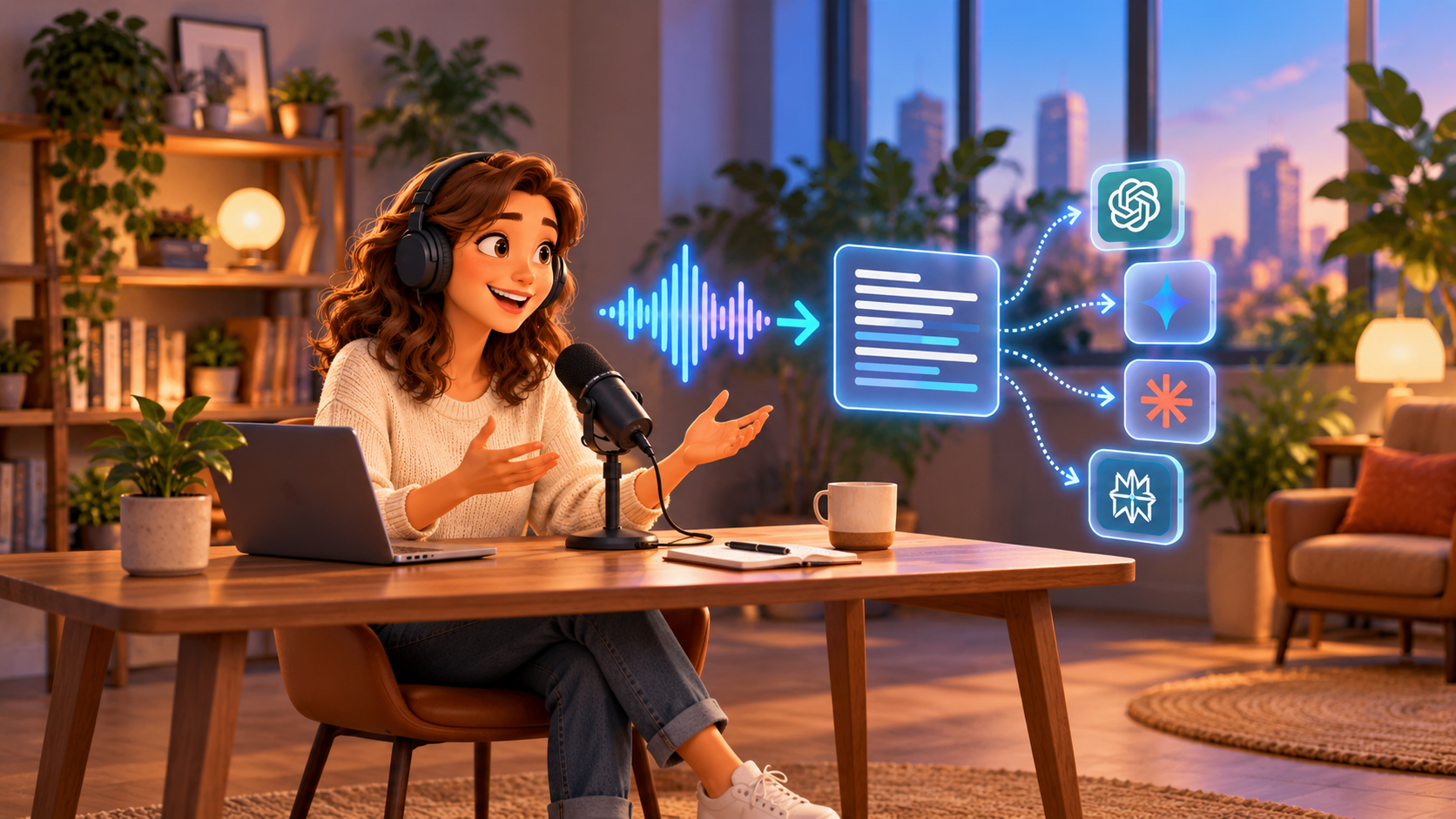
You have a podcast. You host experts, you defend ideas, you build credibility episode after episode. And yet, when someone asks ChatGPT, Perplexity or Gemini (the major AI chatbots that now answer in place of a classic Google search) who the voices that matter in your industry are, your name never comes up. The problem is not your content. It is its format.
An AI chatbot does not listen to you. It reads. All of its knowledge of the world comes from text indexed on the web: articles, pages, PDFs, forums. An audio file hosted on Spotify or Apple Podcasts is, for it, a black box. No language model is going to open your MP3 to extract its substance. What matters for generative engine optimization, the discipline of making your content citable by AI rather than simply well ranked on Google (known as GEO), is what exists around the audio. The text that comes with it, or the lack of it.
The blind spot of most podcasts
Try it. Search for the name of your show followed by "transcript" or "full text". In the vast majority of cases, nothing. Audio hosting platforms display a title, a two-line description, sometimes a handful of keywords. The real content, the forty minutes that carry the expertise, stays locked inside the audio stream.
That absence has a direct cost. AI chatbots build their answers by citing sources they can read and verify. An episode without a published transcript simply cannot enter that calculation, however good its content. You can have the best market analysis, interview the right expert at the right time: if none of it exists as accessible text, it does not exist for a generative AI.
Conversely, podcasts that publish their full transcripts on their own website, not just as a description on a third-party platform, are starting to appear as sources. Not because AI engines particularly like the audio format. Because the text that comes out of it becomes readable, indexable, citable.
One detail makes things worse: many sites that offer a page per episode build that page entirely in JavaScript, a programming language that generates the content at the moment the page is displayed in a browser. The bots that collect text to feed AI chatbots do not always execute that code. As a result, even when a transcript exists somewhere in the system, the page the bot retrieves can be empty.
Why the conversational format is an underused goldmine
There is a reason podcast transcripts work particularly well once published as text. The way people ask a chatbot questions looks much more like a conversation than a keyword search. Nobody types "best CRM SMB 2026" anymore, as in a classic search engine. People ask "which customer management tool would you recommend to a 20-person company that sells to other businesses, and why".
A podcast, by nature, already answers that kind of question. Two people talking, adding nuance, giving concrete examples, rephrasing an idea three different ways over the course of the exchange: that is exactly the structure sought by the systems that break a user question down into several sub-questions to find the best possible answer before synthesizing it. A blog post written for classic SEO often starts from a rigid structure: title, introduction, bullet list. A conversation starts from doubt, explores, contradicts, decides. It is closer to the way an AI builds its own answer, by assembling fragments rather than reading a fixed sheet.
The challenge is that this richness stays trapped in the audio until someone transcribes it.
Turning an existing podcast into citable content
The good news is that the raw material already exists. There is nothing to reinvent, only to republish in another form. Here is what separates an episode that ends up cited from an episode that stays invisible.
| Element | Invisible to AI chatbots | Citable by AI chatbots |
|---|---|---|
| Hosting | Only on Spotify or Apple Podcasts | Dedicated page on your own website |
| Published content | Title and two-line summary | Full transcript, in plain text |
| Structure | A single forty-minute block of text | Split by topic, with subheadings |
| Attribution | "Our guest explained that..." | Full name, role and company of each speaker |
| Technical format | Page built entirely in JavaScript | Simple version, readable without running any script |
A transcript alone is not enough if it is poorly structured. A forty-minute block with no subheadings is hard to use, even for a system able to read a huge amount of text at once. It is better to split the episode into thematic sections, each with a clear title, exactly as you would structure an in-depth article. A chatbot looking for your position on a specific topic must be able to land on the right passage, not drown in the whole conversation.
You also need to name things properly. "Our guest explained that..." carries no authority. "Claire Dubois, marketing director at a company in the sector, explained that..." gives the AI something to assess the credibility of the source, exactly as it would with an article signed by an identifiable author.
On the tooling side, automatic transcription is no longer an obstacle. Audio-to-text transcription services abound, some of them free, and produce in a few minutes a raw text that is 90 to 95% accurate. The real work starts afterwards: proofreading, splitting into sections, correcting proper names, adding titles. It is an afternoon of work per episode, not a months-long project. For a podcast that has been running for two years, it is a job to plan in batches of ten episodes rather than all at once.
The risk of betting everything on third-party platforms
One last point deserves to be stated clearly, because it is rarely anticipated. Publishing a podcast only on Spotify or Apple Podcasts means building your visibility on ground you do not own. These platforms do not publish full transcripts as open text, accessible to the bots that crawl the web to feed AI chatbots. Even when they offer automatic captions, that text often stays locked inside their own interface, invisible from the outside.
The only version of the content that counts for visibility in AI chatbots is the one you publish yourself, on a domain you control. It is the same logic as for any other content: a brand that only publishes on a social network gives up part of its citability, because it leaves another company in control of the page and of its access for bots. Podcasts are no exception. The audio can live on every platform in the world. The text that captures its substance must live with you, on a page you control from the first word to the last.
A podcast that has been active for two or three years often represents dozens of hours of expertise never turned into usable content. It is a stock of content already produced, already validated by an audience, that only needs to be republished in a form AI can read. Before launching a new series of articles or hiring a writer to produce content from scratch, it is often better to start by reopening the podcast archives. The material is there. Only the text is missing.
Vurto analyzes how readable your existing content is for AI chatbots, whether it is a product catalog, an entire website or a library of transcripts, and pinpoints exactly what still keeps you from being cited.